

SR&ED Tax Credits Now Increased
Scitax Bulletin #83
Download PDFSR&ED Tax Credits Now Increased
Read the text from page 1
Bulletin Number 83 | April 3, 2026
SR&ED R&D tax credits now increased – know what it means for you.
Disclaimer
This bulletin is provided as a free service to clients and friends of Scitax Advisory Partners. While the content is believed to be accurate and reliable as of the date it is written, it is general in nature and should be taken as indicative of opportunities rather than definitive for any specific business situation. It is not a substitute for qualified professional advice.
Any ITC or deduction figures in this bulletin are derived using approximate calculation methods; appropriate tax preparation software must be used for exact figures. Unless otherwise noted, examples assume provincial tax filing in Ontario.
© 2026 Scitax Advisory Partners LP. All rights reserved. Scitax is a trademark of Scitax Advisory Partners LP.

Read the text from page 2
About Scitax Advisory Partners LP
Scitax Advisory Partners LP is a Canadian professional services firm with specialist expertise in all aspects of planning, preparing and defending Scientific Research and Experimental Development (SR&ED) tax credit claims.
Our services include identifying eligible R&D work, preparing technical submissions, implementing compliance systems and negotiating claim settlements with the Canada Revenue Agency. Scitax works on a non-competitive basis with the accounting firm of your choice.
David Hearn – Managing Director
David Hearn is a senior expert on Canada’s SR&ED R&D tax credit program. Since entering the field in 1993, he has handled or supervised thousands of successful SR&ED filings.
Before forming the Scitax Partnership in 2006, David was a member of the tax credit practice of an international accounting firm. His experience includes crafting SR&ED submissions, negotiating settlements with CRA, preparing notice-of-objection appeals, assisting legal counsel in Tax Court of Canada actions and providing expert witness testimony. Before his tax consulting career, he held R&D and engineering positions in the electronics industry.
In 2026, Scitax celebrates its 20th anniversary. Learn more at www.scitax.com.
Read the text from page 3
Topline summary
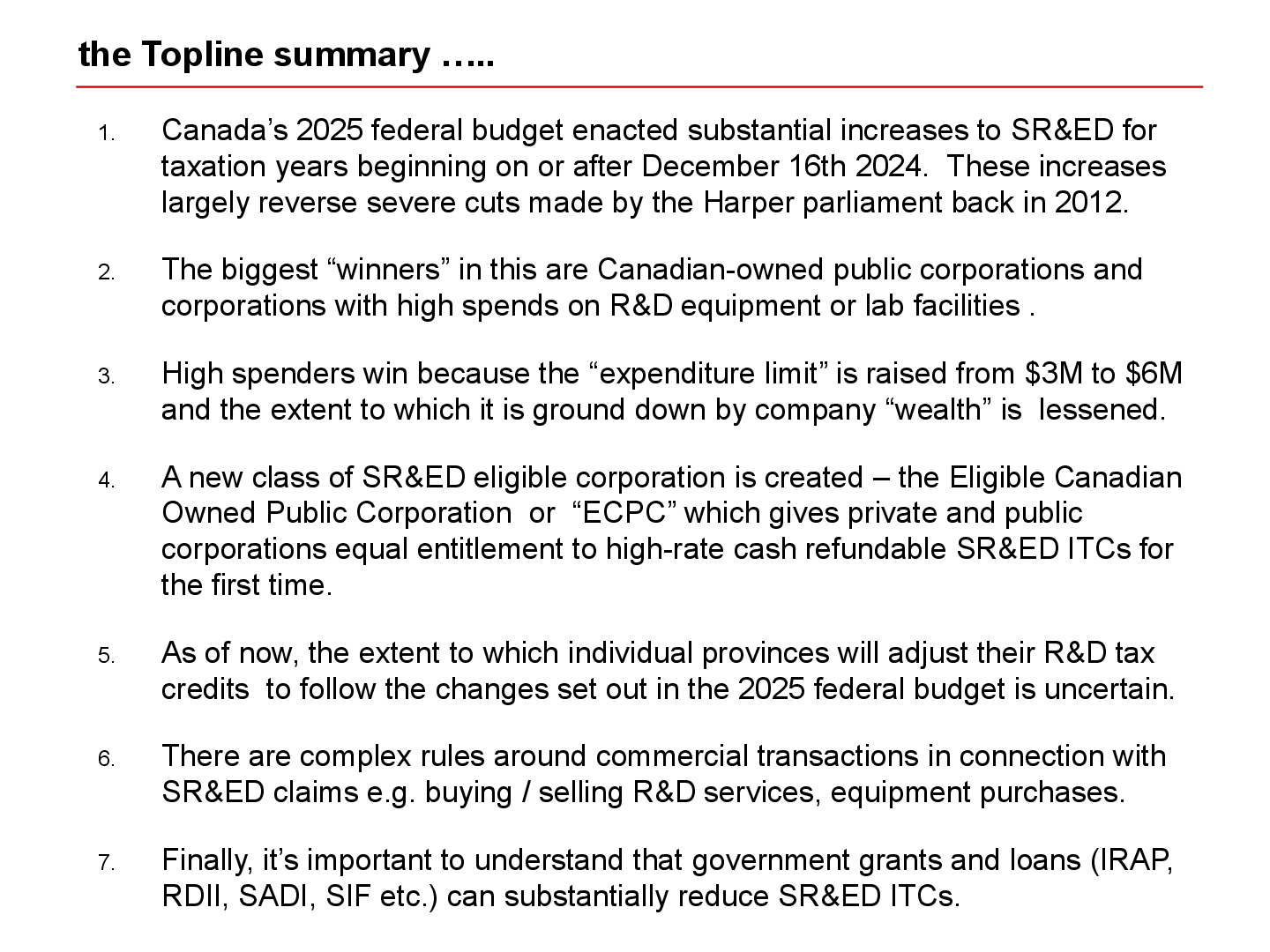
- Canada’s 2025 federal budget enacted substantial SR&ED increases for taxation years beginning on or after December 16, 2024. These increases largely reverse severe cuts made by the Harper Parliament in 2012.
- The biggest beneficiaries are Canadian-owned public corporations and corporations with high spending on R&D equipment or laboratory facilities.
- High spenders benefit because the expenditure limit rises from $3 million to $6 million and the extent to which company wealth reduces that limit is lessened.
- A new class of SR&ED-eligible corporation is created: the Eligible Canadian-Owned Public Corporation (ECPC). For the first time, private and public corporations can have equal entitlement to high-rate, cash-refundable SR&ED ITCs.
- It remains uncertain how individual provinces will adjust their R&D tax credits in response to the 2025 federal budget changes.
- Complex rules apply to commercial SR&ED transactions, including buying or selling R&D services and purchasing equipment.
- Government grants and loans, including IRAP, RDII, SADI and SIF, can substantially reduce SR&ED ITCs.
Read the text from page 4
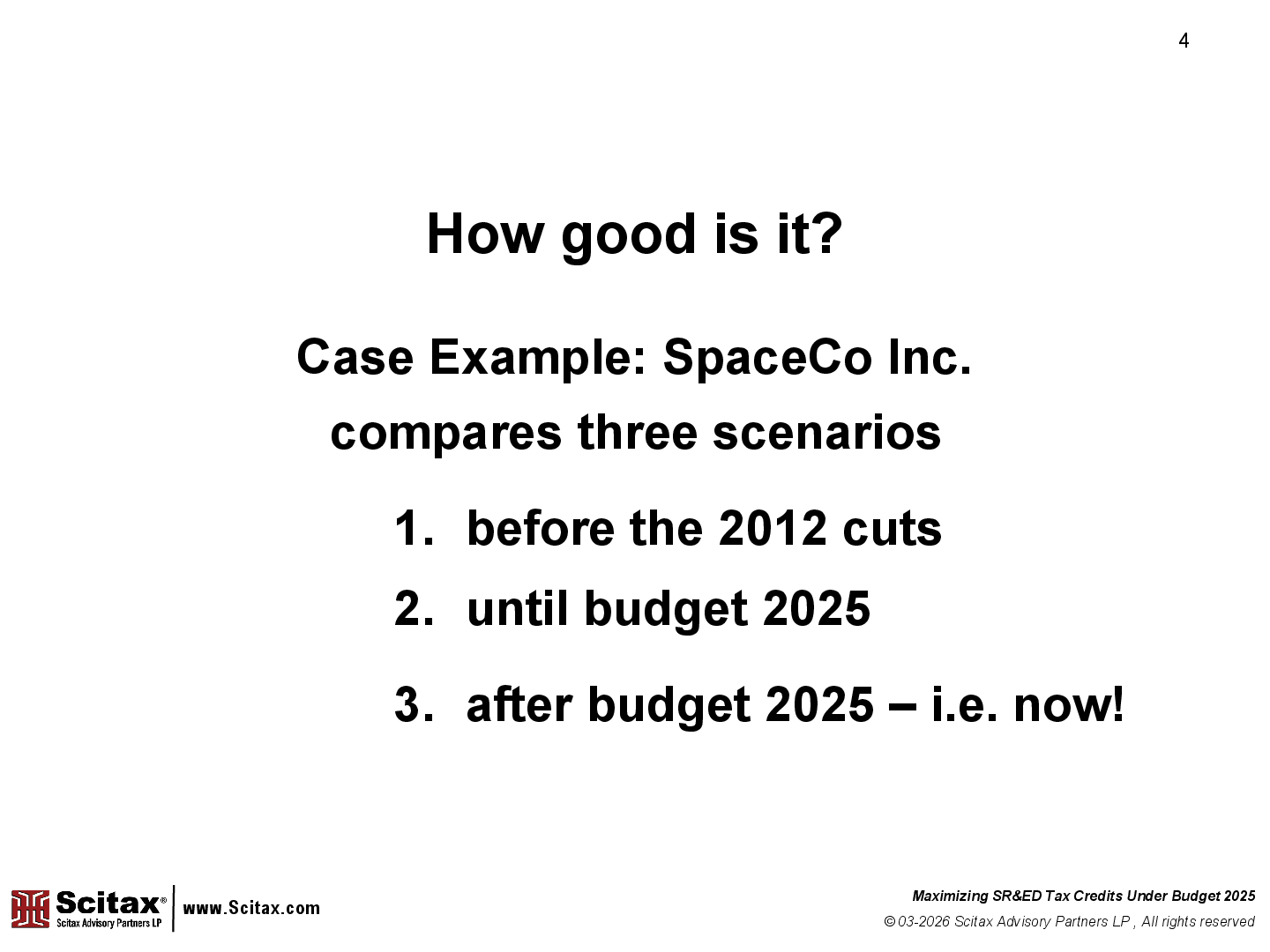
How good is it?
Case example: SpaceCo Inc.
This bulletin compares three scenarios for SpaceCo Inc.:
- Before the 2012 cuts;
- Up to Budget 2025; and
- After Budget 2025 – the rules now in effect.
Read the text from page 5
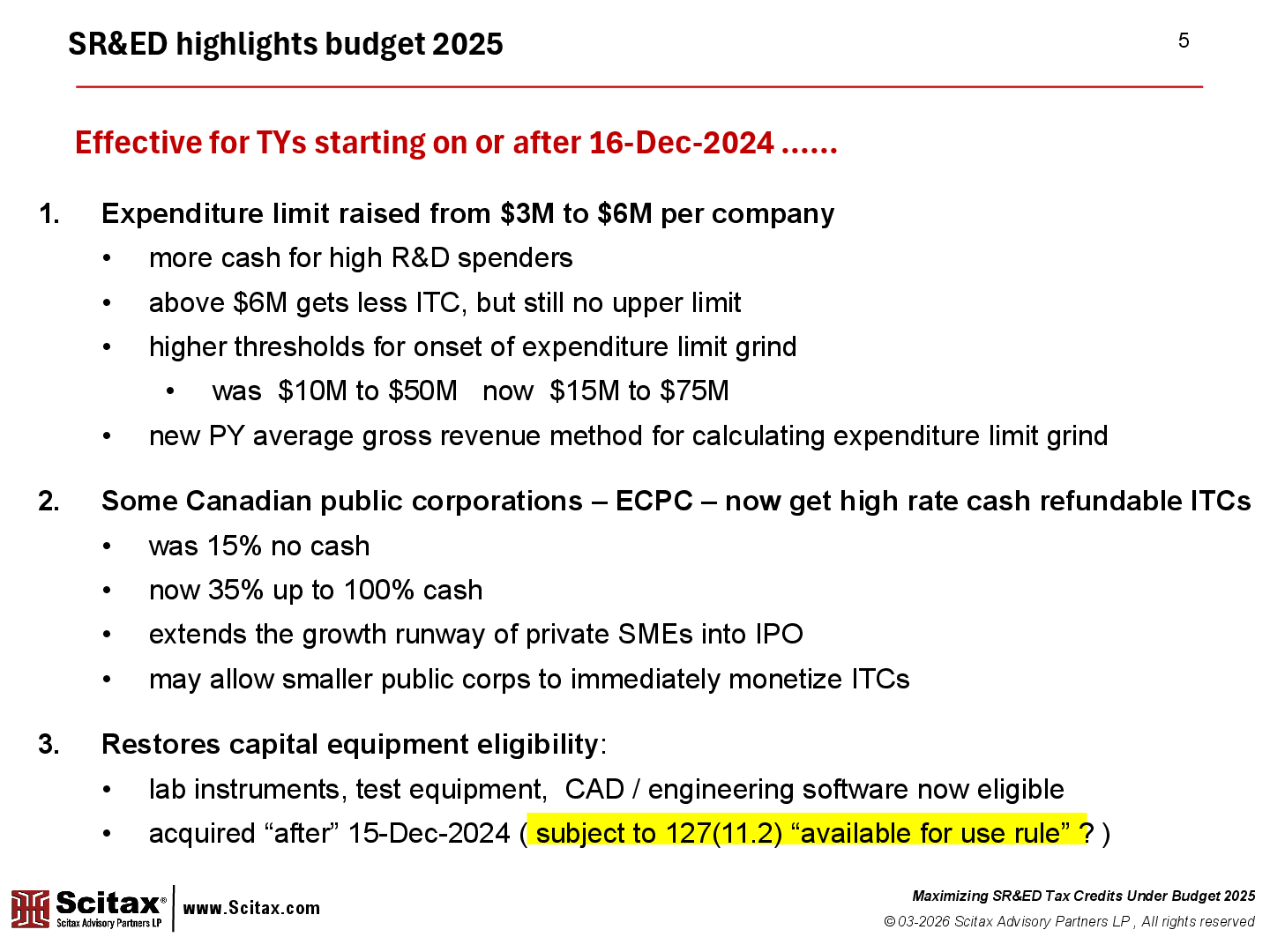
SR&ED highlights in Budget 2025
Effective for taxation years beginning on or after December 16, 2024:
- The expenditure limit rises from $3 million to $6 million per company.
- This means more cash for high R&D spenders.
- Expenditures above $6 million receive a lower ITC rate, but there is still no upper limit.
- The thresholds for the expenditure-limit grind rise from $10 million to $50 million to $15 million to $75 million.
- A new prior-year average gross-revenue method is used to calculate the expenditure-limit grind.
- Some Canadian public corporations, known as ECPCs, now receive high-rate, cash-refundable ITCs.
- Previously, the rate was 15% with no cash refund.
- It is now 35%, with up to 100% cash refundability.
- This may extend the growth runway for private SMEs approaching an IPO and allow smaller public corporations to monetize ITCs immediately.
- Capital equipment eligibility is restored.
- Eligible items include laboratory instruments, test equipment and CAD or engineering software.
- The equipment must be acquired after December 15, 2024 (subject to 127(11.2) “available for use rule” ?).
Read the text from page 6
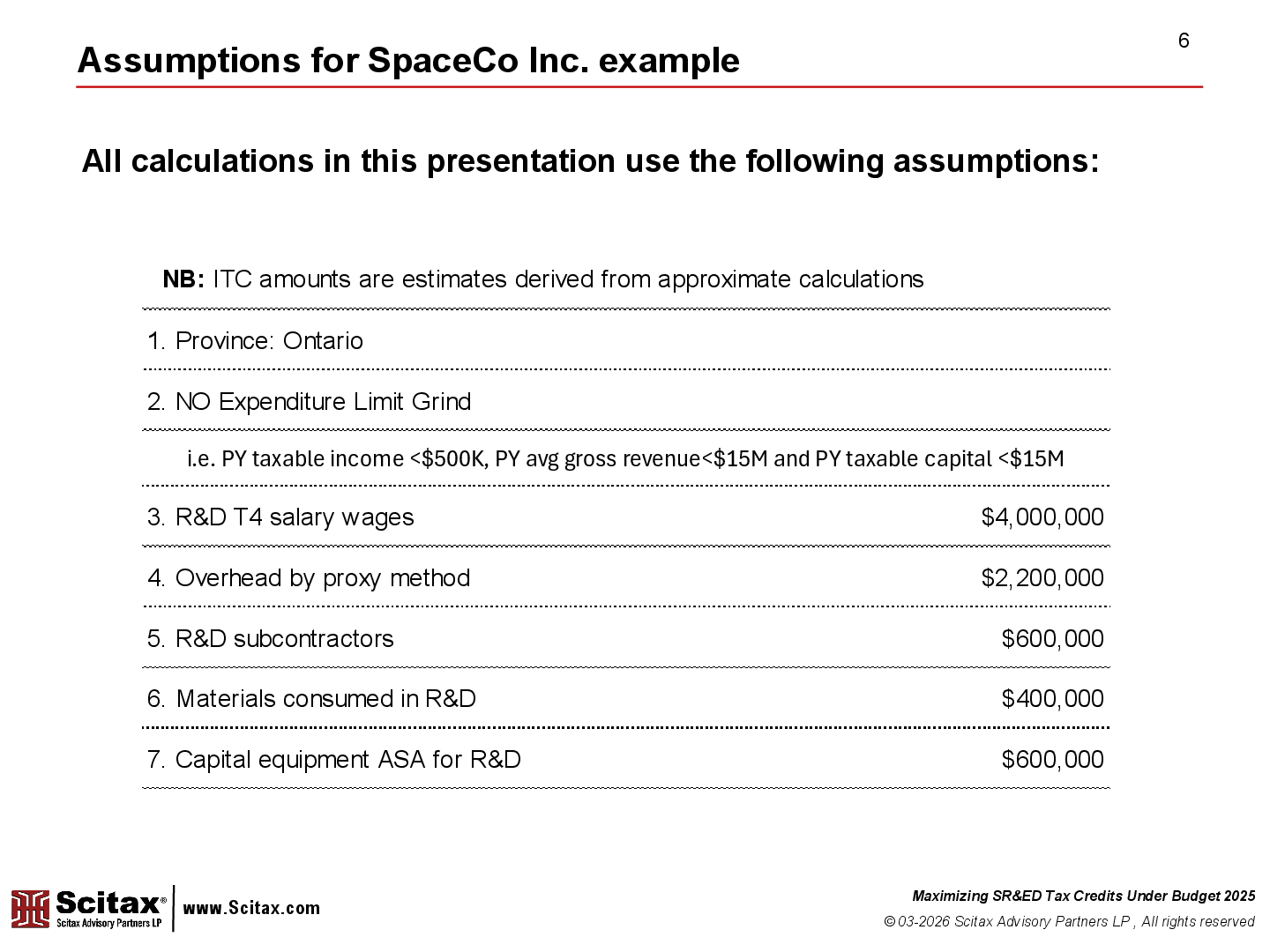
Assumptions for the SpaceCo Inc. example
All calculations in this presentation use the following assumptions. ITC amounts are estimates derived from approximate calculations.
- Province: Ontario.
- No expenditure-limit grind: prior-year taxable income is below $500,000, prior-year average gross revenue is below $15 million and prior-year taxable capital is below $15 million.
- R&D T4 salary wages: $4,000,000.
- Overhead calculated using the proxy method: $2,200,000.
- R&D subcontractors: $600,000.
- Materials consumed in R&D: $400,000.
- Capital equipment available for use in R&D: $600,000.
Read the text from page 7
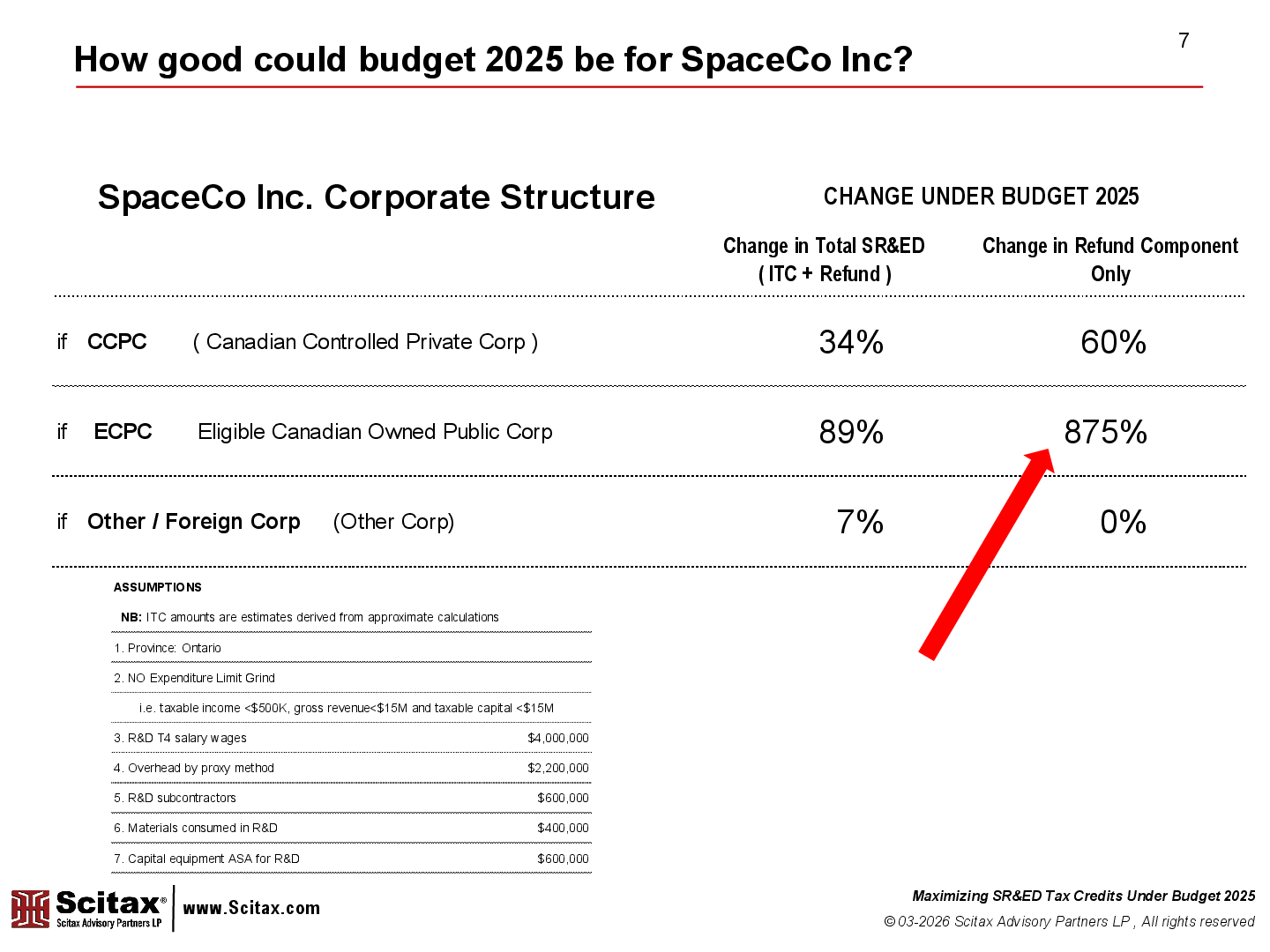
How good could Budget 2025 be for SpaceCo Inc.?
Using the assumptions on the previous page, the chart compares the change in total SR&ED benefit (ITC plus refund) and the change in the refund component:
- CCPC (Canadian-Controlled Private Corporation): total SR&ED benefit increases by 34%; the refund component increases by 60%.
- ECPC (Eligible Canadian-Owned Public Corporation): total SR&ED benefit increases by 89%; the refund component increases by 875%.
- Other or foreign-owned corporation: total SR&ED benefit increases by 7%; there is no change to the refund component.
Read the text from page 8
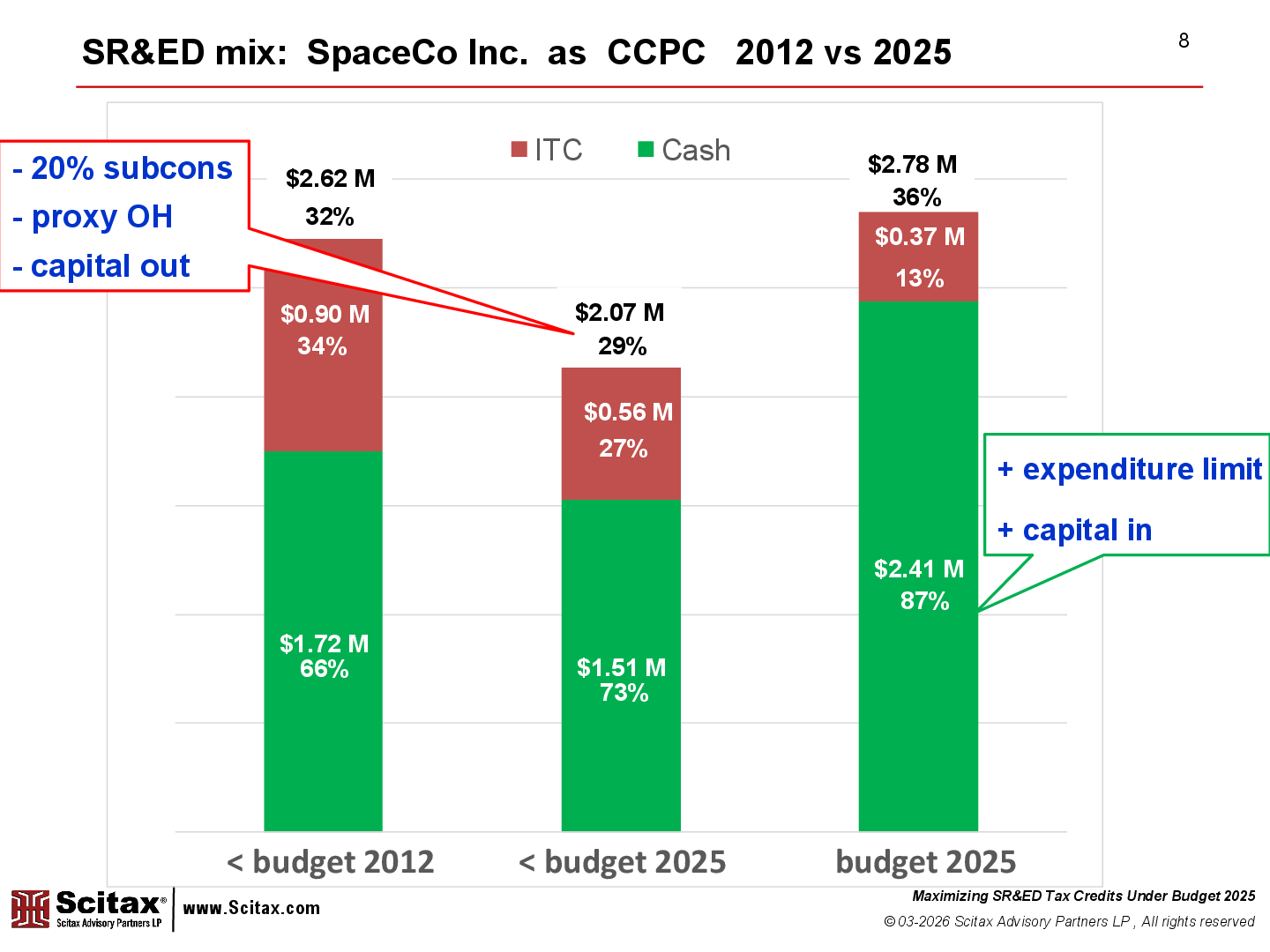
SR&ED mix: SpaceCo Inc. as a CCPC, 2012 vs. 2025
The chart compares the investment tax credit (ITC) and cash portions of SpaceCo Inc.’s SR&ED benefit.
| Scenario | Total benefit | Cash | ITC |
|---|---|---|---|
| Before Budget 2012 | $2.62 million (32%) | $1.72 million (66%) | $0.90 million (34%) |
| Before Budget 2025 | $2.07 million (29%) | $1.51 million (73%) | $0.56 million (27%) |
| Budget 2025 | $2.78 million (36%) | $2.41 million (87%) | $0.37 million (13%) |
The earlier scenarios reflect 20% subcontractors, proxy overhead and capital being excluded. Under Budget 2025, the expenditure limit increases and capital is included.
Read the text from page 9
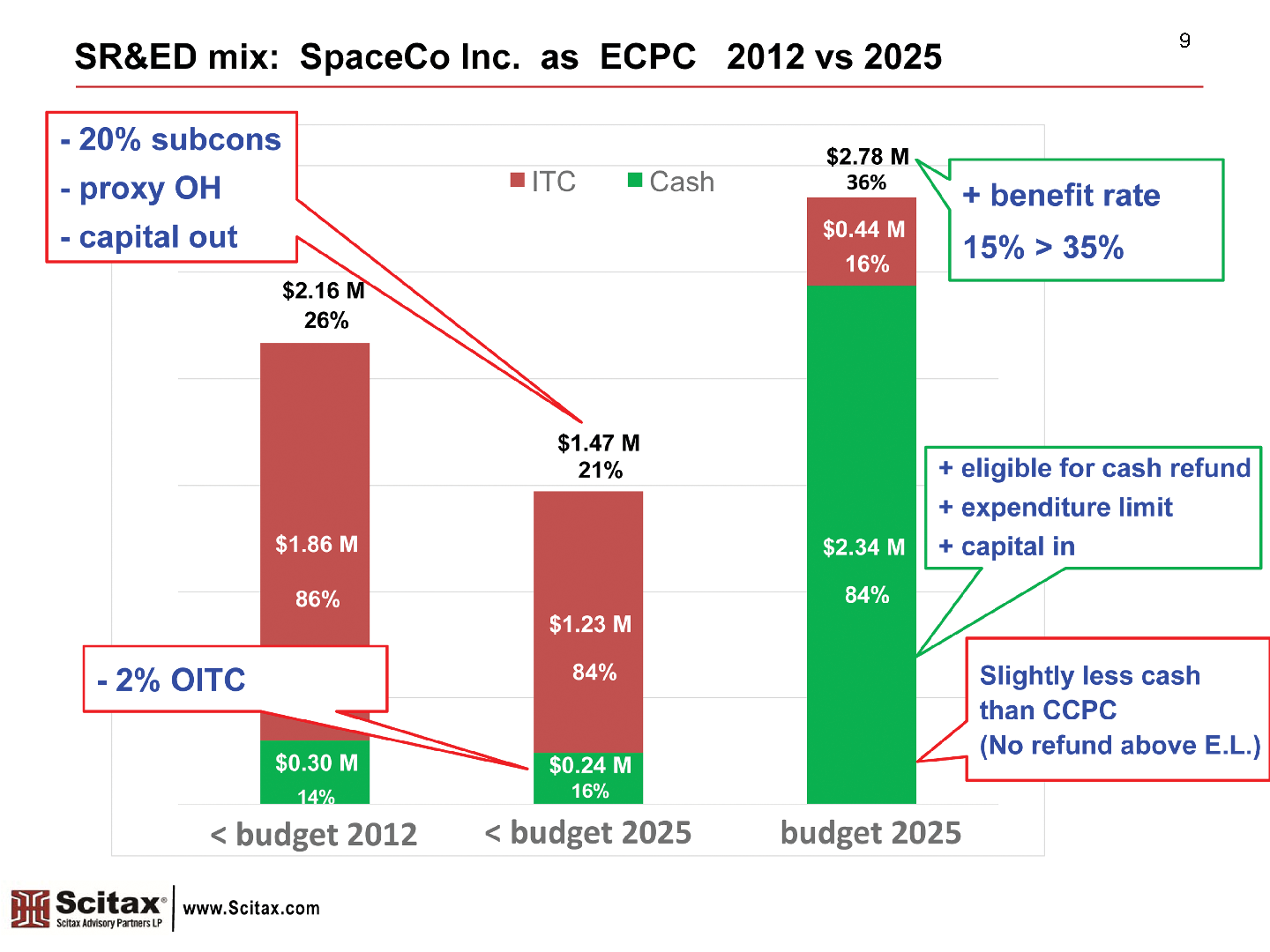
SR&ED mix: SpaceCo Inc. as an ECPC, 2012 vs. 2025
The chart compares the investment tax credit (ITC) and cash portions of SpaceCo Inc.’s SR&ED benefit.
| Scenario | Total benefit | Cash | ITC |
|---|---|---|---|
| Before Budget 2012 | $2.16 million (26%) | $0.30 million (14%) | $1.86 million (86%) |
| Before Budget 2025 | $1.47 million (21%) | $0.24 million (16%) | $1.23 million (84%) |
| Budget 2025 | $2.78 million (36%) | $2.34 million (84%) | $0.44 million (16%) |
- Under Budget 2025, the benefit rate rises from 15% to 35%.
- The ECPC is eligible for a cash refund, the expenditure limit rises and capital is included.
- Cash is slightly lower than for a CCPC because there is no refund above the expenditure limit.
- The earlier scenarios also reflect a 2% Ontario ITC, 20% subcontractors, proxy overhead and capital being excluded.
Read the text from page 10
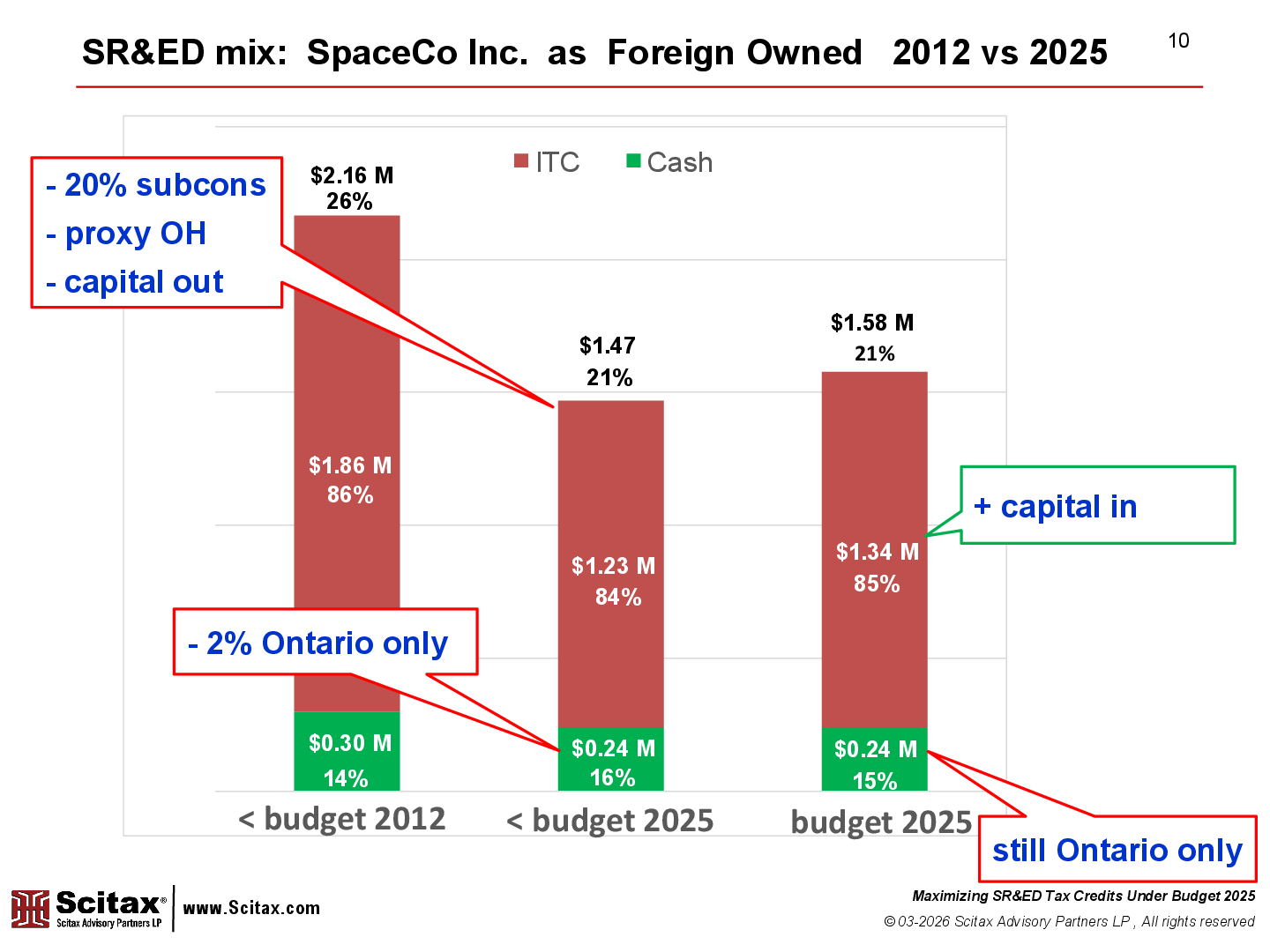
SR&ED mix: SpaceCo Inc. as foreign-owned, 2012 vs. 2025
The chart compares the investment tax credit (ITC) and cash portions of SpaceCo Inc.’s SR&ED benefit.
| Scenario | Total benefit | Cash | ITC |
|---|---|---|---|
| Before Budget 2012 | $2.16 million (26%) | $0.30 million (14%) | $1.86 million (86%) |
| Before Budget 2025 | $1.47 million (21%) | $0.24 million (16%) | $1.23 million (84%) |
| Budget 2025 | $1.58 million (21%) | $0.24 million (15%) | $1.34 million (85%) |
The earlier scenarios reflect 20% subcontractors, proxy overhead and capital being excluded, along with a 2% Ontario ITC. Budget 2025 adds capital back in, but the Ontario-only limitation remains.
Read the text from page 11
Contact Scitax
David Hearn
Managing Director
Scitax Advisory Partners LP
www.scitax.com
dhearn@scitax.com
(416) 646-2212
The Exchange Tower
130 King Street West, Suite 2300, PO 233
Toronto, Ontario M5X 1C8