

Statistics Reveal Dramatic Increase in SR&ED Appeals
Scitax Bulletin #55
Download PDF
DIRECTORS:
David R. Hearn, Managing Director
Michael C. Cadesky, FCPA FCA BSc MBA
Statistics Reveal Dramatic Increase in SR&ED Appeals
SR&ED-Related Notice of Objection Filings Increased by Factor of 25 Since 2007
Government statistics obtained by Scitax via Canada's "Access to Information" process indicate that the number of Notice of Objection filings taxpayers made to the Canada Revenue Agency on SR&ED tax credits has skyrocketed over the last seven years.
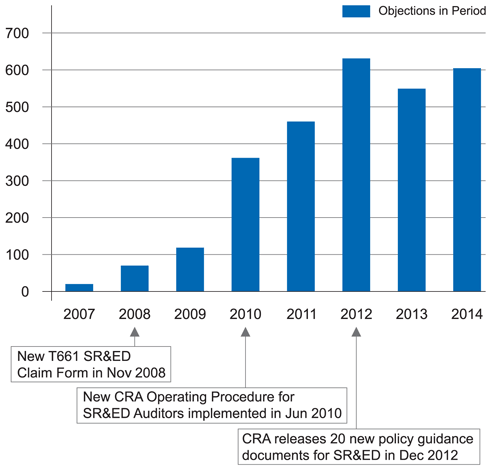


The objection counts in these statistics are referencedby government fiscal year which for Canada is April 1st to March 31st. Therefore on the above graph "2012" refers to objections in the time period 1-Apr-2011 to 31-Mar-2012. The figure for 2014 is extrapolated linearly based on the assumption that the count CRA provided at March 2014 was for 11/12ths of the year.
The Notice of Objection is the first step of formal redress that a taxpayer takes in attempting to resolve a dispute with CRA and is a prerequisite to appealing the matter in the Tax Court of Canada. Therefore the number of Objections is a good bellweather indicatorof disputes between CRA and taxpayers. In this case the data heralds a massive increase in objections indicative of a growing disconnect between industry and the CRA with respect to what types of R&D activity qualify to attract the SR&ED tax credits.
Given that the Notice of Objection must be filed within 90 days of the date of assessment which for tax filings involving SR&ED generally arrives 6 to 18 months after the claim is filed, objections filed in a given year generally arise from claims filed over the course of the preceding two years. For example the majority of the 600 plus objections that CRA says werereceived in 2012 would relate to claims filed for tax years ended 2010 and 2011. In some cases CRA audits claims from multiple tax years at a time, so the 2012 objection bulge could result from tax filingsas far back as 2009 which would coincide with CRA's introduction of the "new" T661 form in 2008.
The trendline of the increase in Objections tracks three key changes in CRA's administration of the SR&ED program:
o November 2008: CRA introduces a new SR&ED claim form (T661-08) featuring new definitions for certain key parameters of SR&ED eligibility (e.g. "technological obstacles" versus the previous "technological uncertainties" etc.) coupled with a much more "data-centric" approach whereby the taxpayer was required to provide various "elds of fitick box" information (e.g. "field of science code" etc.) which made down-screening claims for audit a lot easier.
o June 2010: CRA implements new standard operating proc edures for SR&ED auditors laid down in a document entitled "Claim Review Manual". Henceforth audits become longer in duration and deeper in scope; financial and science audits are almost always done together. Pre-audit information request letters become commonplace in most jurisdictions. There is a marked increase in the level of supporting documentation (technical working papers and time keeping records) demanded by CRA auditors to corroborate an SR&ED claim.
o December 2012: CRA releases 20 new "SR&ED guidance documents" that set out new / updated policies on what R&D activity and expenditures CRA will accept as eligible to attract SR&ED. Although released in December 2012, the policy review project by which they were created started in 2007 with many draft editions produced in 2010 and 2011. Many believe that these policies were in use by CRA auditors for several years prior to their release as final. Subsequent to the release of these policies Dr. Russ Roberts of the Cana dian Advanced Technology Association (CATA) wrote: fiOver the last several years, many SR&ED claimants have experienced CRA SR&ED reviews that have been conducted using these new concepts. The result of the new, consolidated policies when used in audits has been support for a much narrower scope of SR&ED, both in terms of what are SR&ED projects and what work can be associated with them.fl


How accurate are these statistics? According to various figures released by CRA and other arms of the Canadian Federal Government about 18,000 SR&ED claims are filed every year – amounting to federal-level benefit payouts in the range of $3 – $4 billion per year. This amount is matched by an additional $1 – $1.5 billion in payouts from the provinces to anyone receiving the federal-level credit. Assuming 18,000 claims per year, some of the figures provided by CRA in response to our request seem rather low (e.g. only 22 SR&ED objections are shown for 2007). However while the absolute numbers might be off, we believe the trendline is valid and that there has in fact been a tremendous surge in the number of SR&ED-related Notices of Objections since 2007.
It is worth noting the following figures for changes in federal level SR&ED payouts over the last five years; the decline in payouts from 2009 to 2010 nicely tracks the increase in the number of objections reported for that same period.
| SR&ED BENEFIT PAYOUTS (CANADA FEDERAL LEVEL) |
|
|---|---|
| 2008 | $4.1 B |
| 2009 | $4.1 B |
| 2010 | $3.3 B |
| 2011 | $3.5 B |
| 2012 | $3.6 B |
| 2013 | $3.6 B |
Source: The CRA's Annual Reports to Parliament for years 2008 to 2013 as cited by CATA in "What's happened to SR&ED support for the Digital Sector?" 14-Jan-2014.


LEARN MORE
Read our access to information (ATIP) request and the data provided in response to it by the Canadian Government
https://scitax.com/pdf/A-069357.Client.Package.pdf
Scitax Bulletin #51 Appealing an SR&ED Claim
https://scitax.com/pdf/Bulletin.51-Appealing.SRED.Claims.05-Jun-2012.pdf
Scitax Bulletin #37 CRA to Release New T661 Significant Changes in SR&ED Filing Requirements Expected
https://scitax.com/pdf/bul-037.pdf
Report: "What's happened to SR&ED support for the Digital Sector?" Dr. Russ Roberts, Advanced Technology Association, Jan 2014
http://www.cata.ca/Media_and_Events/Press_Releases/cata_pr01291402.html
SR&ED Advisory & Alert: "CRA Policy Consolidation" Dr. Russ Roberts, Advanced Technology Association Dec 2012
http://www.cata.ca/Media_and_Events/Press_Releases/cata_pr02011302.html


About Scitax
Scitax Advisory Partners LP is a Canadian professional services firm with specialist expertise in all aspects of planning, preparing and defending Sc ientific Research and Experimental Development (SR&ED) tax credit claims.
We offer a multi-discipline team of engineers, chartered accountants and tax lawyers to ensure that your SR&ED issues are covered from every angle.
While we normally work in concert with our client's existing accountants, our affiliated tax-dedicated chartered accounting firm – Cadesky and Associates LLP – is an expert resource for advice on any taxation matter such as may arise either during the planning and preparation of your claim or while dealing with CRA afterwards.
In addition to planning and preparing new claims, wealso engage on claims that have been challenged by CRA auditors or that have received negative assessments for either scientific or expenditure eligibility. If a satisfactory settlement cannot be achieved with CRA at the local office level, we will appeal your assessment through either Notice of Objection or Tax Court of Canada procedures with the assistance of our affiliated firm of tax lawyers.

DIRECTORS:
David R. Hearn, Managing Director
Michael C. Cadesky, FCPA FCA BSc MBA
Scitax Advisory Partners LP
Exchange Tower, 130 King Street West, Suite 2300, PO Box 233, Toronto ON M5X 1C8 | 416-350-1214 | www.scitax.com
Disclaimer
This bulletin is provided as a free service to clients and friendsof Scitax Advisory Partnersand Cadesky and Associates. Thecontent is believed tobe accurate and reliable as of the date it is written, but isnot a substitute for qualified professional advice.
© Copyright Scitax Advisory Partners LP, 2014. All rights reserved. "Scitax" is a trade-mark of Scitax Advisory Partners LP.
